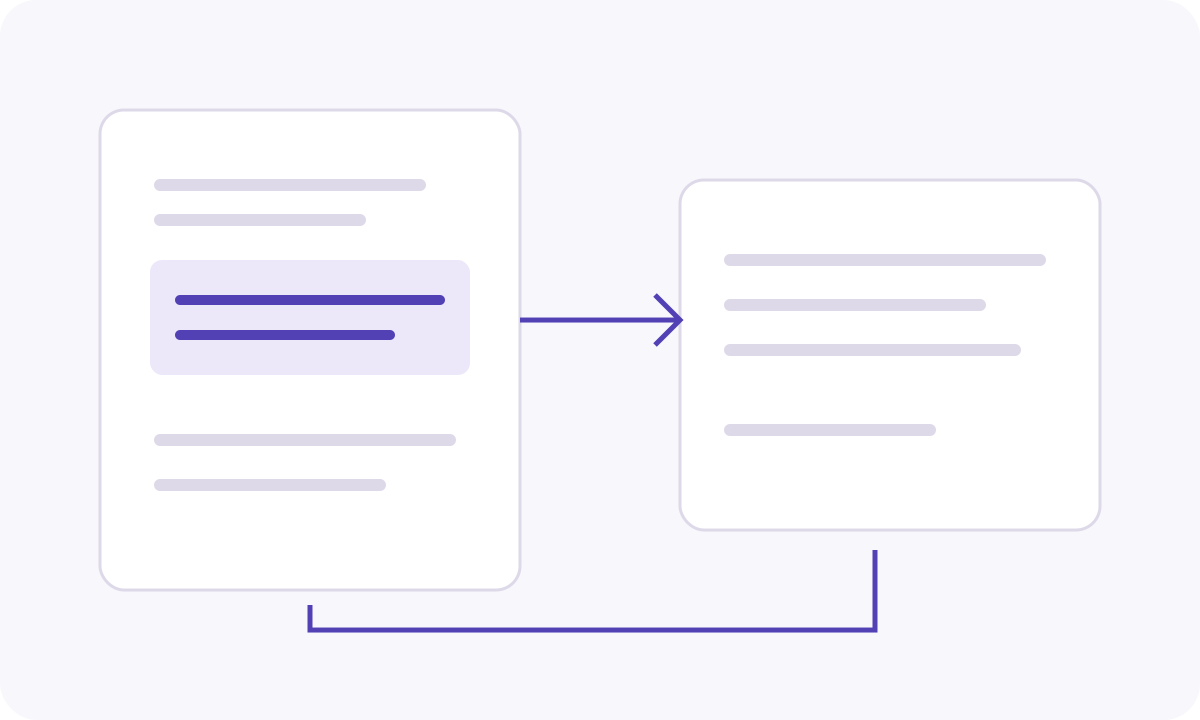
A transcript can help you prepare an article or short summary, but copying words out of it does not verify them. Recognition errors, missing context and an overly tidy edit can all change what a speaker appears to have said. This is a manual editorial workflow: Transcribana does not automatically generate articles, summaries or rewritten quotations.
Define the new work and the source
Choose the intended form before cutting text: a direct quotation, your own summary or a background explanation. Keep the exact recording version and a checked location for each important passage. A transcript timestamp is a navigation aid, not independent proof that a quotation is accurate. Listen before relying on it.
Check the relevant permissions, attribution agreement and intended audience. Possession of a recording is not a blanket permission to republish it. Local processing does not settle those questions. If a source is private, keep review notes and excerpts within the appropriate audience rather than sending them to an unrelated tool for convenience.
Verify the full thought before selecting a sentence
Replay what comes before and after the excerpt. A question, a condition or a later correction may limit the apparent claim. Confirm the speaker when attribution matters; the tool does not automatically establish identity. Check names, numbers and negatives separately because a grammatical sentence can still reverse meaning.
The meeting and interview review guide provides a decision log for this work. Store unresolved doubts explicitly. Do not convert a plausible spelling or an expected answer into a verified fact simply because it fits the surrounding article.
Label quotation and paraphrase honestly
Invented source sentence: “We may launch in June if the review is complete; no date is confirmed.” The following examples are teaching material, not statements from a real customer or a measured recognition result.
On a narrow screen, scroll the table sideways to read every column.
| Proposed reuse | Assessment | Reason |
|---|---|---|
| “We may launch in June if the review is complete; no date is confirmed.” | Faithful quotation if verified against the source | Preserves possibility, condition and lack of confirmation. |
| The speaker described a possible June launch dependent on review, without a confirmed date. | Labeled paraphrase | Uses new wording while retaining the limits of the statement. |
| “We will launch in June.” | Reject as a quotation | Invents certainty and removes the condition. |
| June launch confirmed | Reject as a headline derived from this source | A headline can distort the source even without quotation marks. |
Shorten without silently strengthening the claim
Remove repetition only when the purpose and editorial policy allow it, and do not remove words that control certainty or scope. “Some participants” is not “participants”, and “could” is not “will”. If an excerpt needs extensive rewriting to fit your sentence, paraphrase transparently instead of putting new language inside quotation marks.
Keep explanations, transitions and interpretation separate from attributed speech. An editorial note can help readers understand context, but it must not look like something the speaker said. For quotations translated by a human in a separate workflow, identify that distinction and check meaning; this app does not provide an automatic translation step here.
Build a summary from checked points
Write a short list of verified points before drafting a summary. Beside each point, record its source location and whether it is a statement, proposal, example or your inference. When two passages disagree, do not silently choose the cleaner version. Revisit the recording or note the disagreement rather than manufacturing a single confident narrative.
A writing suggestion can fix spacing or grammar but cannot prove an assertion or authorize a quotation. Copy Text and TXT follow the selected document version; SRT, VTT and JSON preserve canonical timed segments. Save the version you intend to reuse and do not assume a corrected reading copy has updated every export.
Check the final article, not only the excerpt
Read the headline, introduction and captions beside the source. These surrounding elements can imply a stronger claim than the quotation itself. Check attribution, dates and any links you added; never invent a citation to make an unsupported statement look researched. Keep factual claims separate from opinion and unresolved interpretation.
For a podcast-derived article, also match the published audio version using the podcast workflow. Keep source and reviewed copy together, and note consequential corrections. Reuse is successful when a reader can understand what was said and what you added—not merely when the new prose sounds polished.
- Identify the new format and exact source.
- Check permissions and attribution.
- Listen before and after the passage.
- Preserve qualifications, quantities and negatives.
- Label paraphrases and editorial additions.
- Tie summary points to checked evidence.
- Review headlines and final context against the source.